01
AI enters daily work
Assistants, copilots, retrieval systems, coding agents, and workflow agents are becoming part of ordinary operations.
How Leaders Can Build Trust Before AI Scales Beyond Control
A leadership book for governing data, AI systems, and autonomous agents before speed, scale, and automation turn weak governance into institutional failure.
The book’s promise
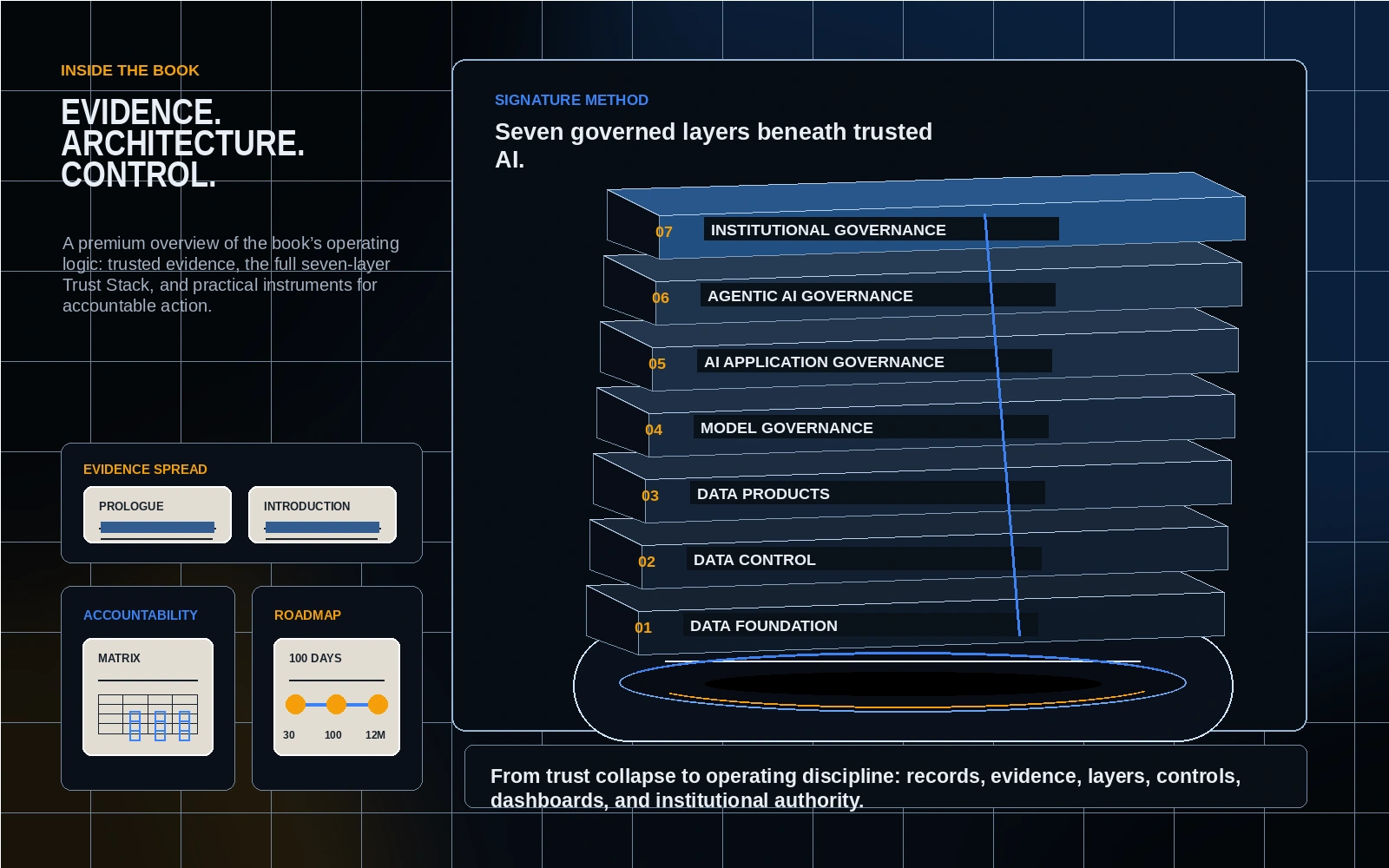
Inside the book
The book moves from narrative evidence to governance architecture and practical instruments leaders can use.
AI is no longer confined to experiments, labs, or isolated automation projects. It is entering board packs, customer service, software development, public administration, procurement, security operations, research, legal workflows, and decision systems.
The danger is not only that AI may produce a wrong answer. The deeper danger is that an institution may accept the answer without knowing what data supported it, who owned the decision, what evidence was preserved, what controls applied, or how the mistake would be contained.
Ungoverned Intelligence names that failure pattern and gives leaders a way to act before it becomes public.
01
Assistants, copilots, retrieval systems, coding agents, and workflow agents are becoming part of ordinary operations.
02
Data ownership, permissions, evidence, risk review, model oversight, and escalation often sit in separate silos.
03
As systems begin to recommend, trigger, update, delegate, and act, weak governance becomes institutional risk.
The Prologue opens with a simple institutional problem: a machine produced an answer that looked authoritative, and people trusted it before evidence could prove it.
The first sign of failure is not that AI gives an answer. It is that everyone trusts it too quickly.
No trusted data, no trusted AI.
No evidence, no accountability.
No control, no scale.
Ungoverned Intelligence moves from the oldest foundations of institutional trust to the modern challenge of AI systems and autonomous agents. It shows how records, rules, evidence, ownership, permissions, controls, models, applications, agents, and institutions must work together before intelligence can be trusted at scale.
Explore the book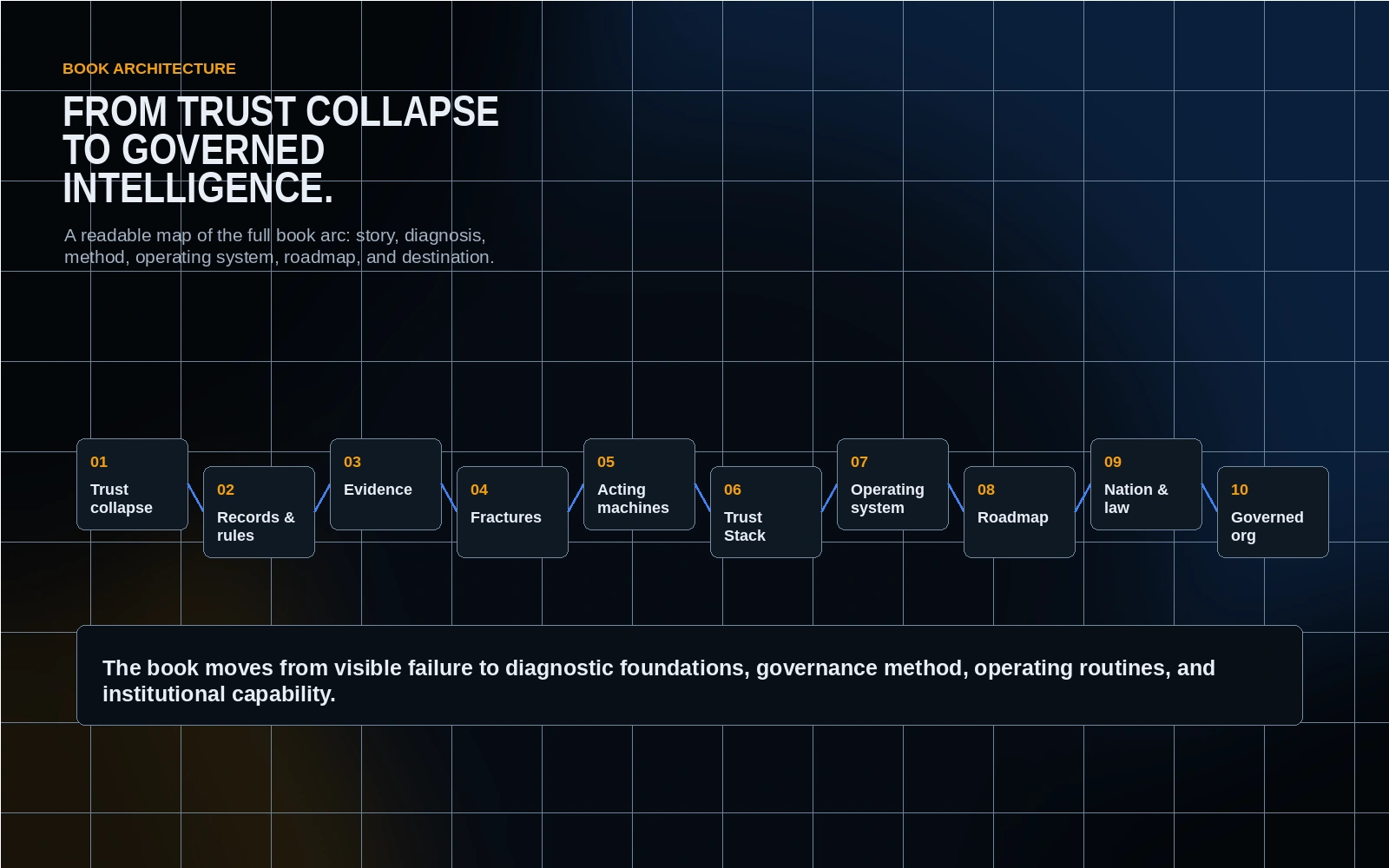
Book architecture
The reader enters through a trust collapse, not an abstract definition.
Governance stops feeling bureaucratic and becomes the infrastructure of scale.
Evidence becomes valuable only when it changes institutional action.
Leaders see the uncomfortable mirror: ownership, quality, permission, accountability, evidence, and control.
The risk changes when systems move from producing answers to taking action.
The central method arrives as relief: a way to govern the layers beneath intelligence.
Governance becomes visible leadership practice through mission control, ownership, controls, and dashboards.
The book becomes executable: 30 days for visibility, 100 days for control, 12 months for capability.
The scale widens from enterprise governance to national readiness and machine-readable governance.
The reader leaves with a leadership choice and practical instruments of action.
Ungoverned Intelligence gives leaders a practical way to see the governance problem beneath AI adoption, explain it clearly, diagnose trust fractures, and build the operating capability required to govern intelligence at scale.
01
A clearer vocabulary for naming the governance problem beneath AI adoption.
02
Real institutional failures and success patterns that make governance memorable.
03
The Trust Stack: a seven-layer architecture for governing intelligence at scale.
04
Practical ways to turn policy statements into assigned, evidenced, monitored, and improved controls.
05
A staged path for the first 30 days, first 100 days, and first 12 months.
Trustworthy AI does not begin at the prompt or the model output. It depends on the data, controls, products, models, applications, agents, and institutions beneath the answer.
Open the Trust Stack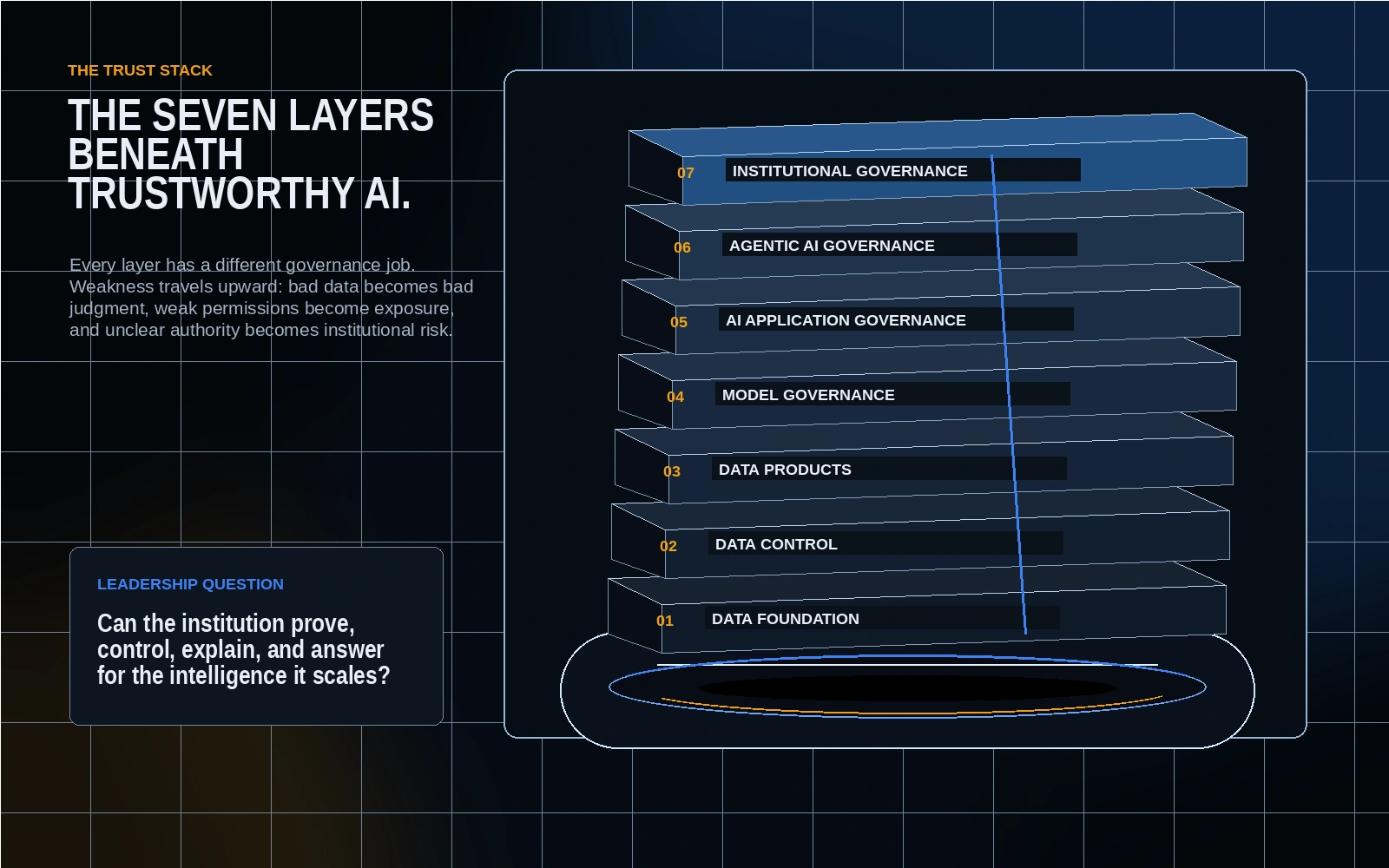
Framework plate
01
Data Foundation
Chapter 1
02
Data Control
Chapter 17
03
Data Products
Chapter 18
04
Model Governance
Chapter 20
05
AI Application Governance
Chapter 21
06
Agentic AI Governance
Chapter 22
07
Institutional Governance
Chapter 23
Many AI failures begin before AI is deployed. They begin in unclear ownership, poor data quality, weak permissions, disputed accountability, missing evidence, and controls that exist on paper but not in operations.
01
Critical data, AI systems, or decisions are used without accountable ownership.
02
Data is incomplete, inconsistent, stale, duplicated, or unsuitable for the decision.
03
AI sees, retrieves, combines, or exposes information beyond approved authority.
04
Responsibility is disputed after deployment because it was not assigned before use.
05
The organization cannot reconstruct the source, prompt, output, approval, decision, or action path.
06
Policies exist, but they do not constrain real operating behavior.
This book is written for leaders who must adopt, scale, regulate, fund, audit, secure, or govern AI while knowing that the institution may not yet have the data foundations, accountability structures, evidence trails, and control systems required to trust it.
The companion toolkit collects registers, checklists, dashboards, matrices, scorecards, and roadmaps that help leaders move from argument to operating discipline.
Preview the Toolkit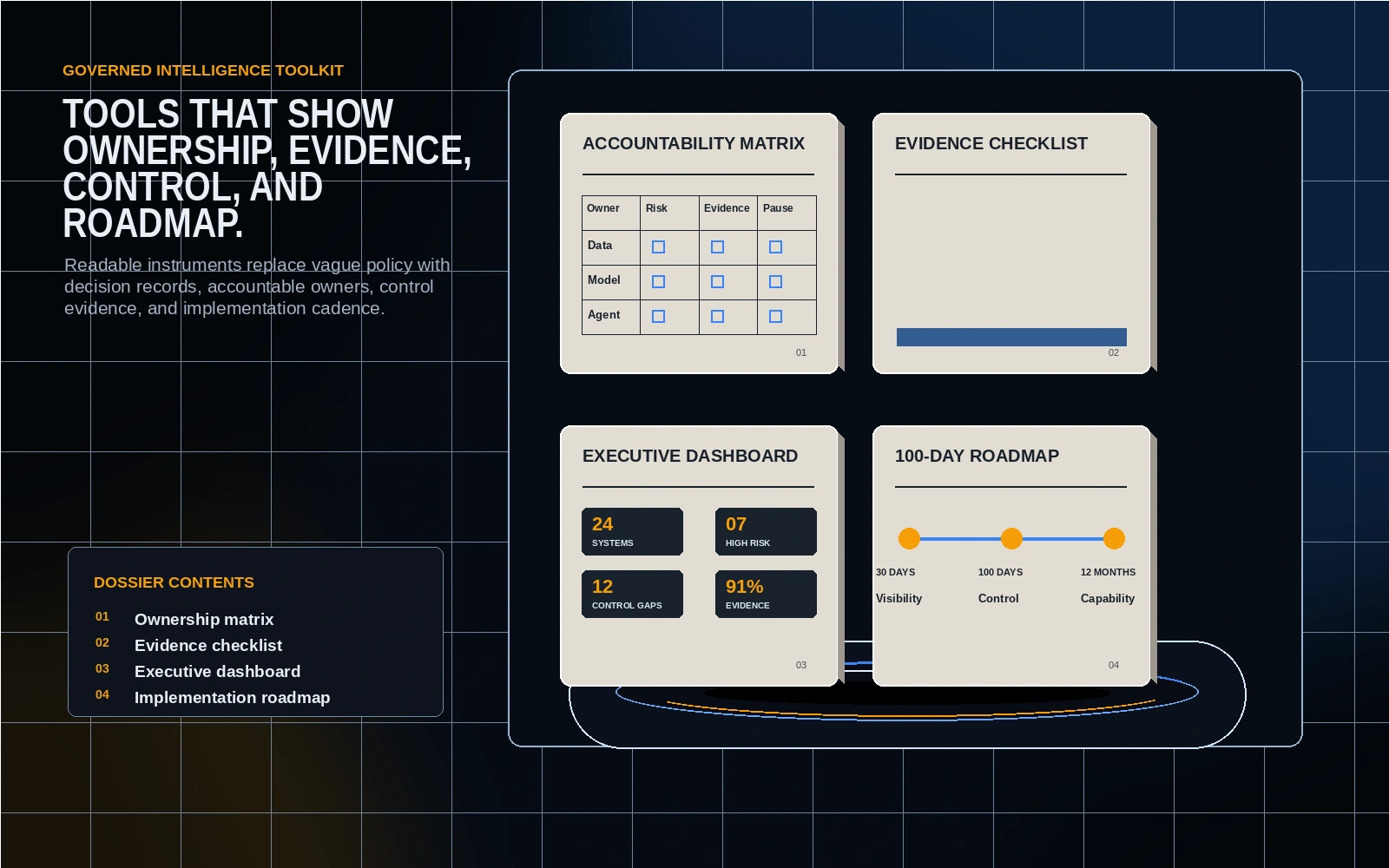
Toolkit preview
01
Critical Data Register
Companion download
02
Minimum Data Trust Checklist
Book tool
03
AI Accountability Matrix
Companion download
04
AI System Ownership Register
Toolkit preview
05
AI Audit Trail Requirements
Book tool
06
Policy-to-Control Conversion Template
Book tool
07
Trust Stack Diagnostic
Companion download
08
Agentic AI Control Checklist
Companion download
09
Executive AI Governance Dashboard
Companion download
10
30-Day AI Governance Starter Plan
Book tool
11
100-Day AI Governance Roadmap
Book tool
12
Governed Organization Scorecard
Toolkit preview
Join the launch list for publication updates, sample releases, toolkit previews, and occasional notes on governing intelligence at scale.