01
Ownership Fracture
Critical data, AI systems, or decisions are used without accountable ownership.
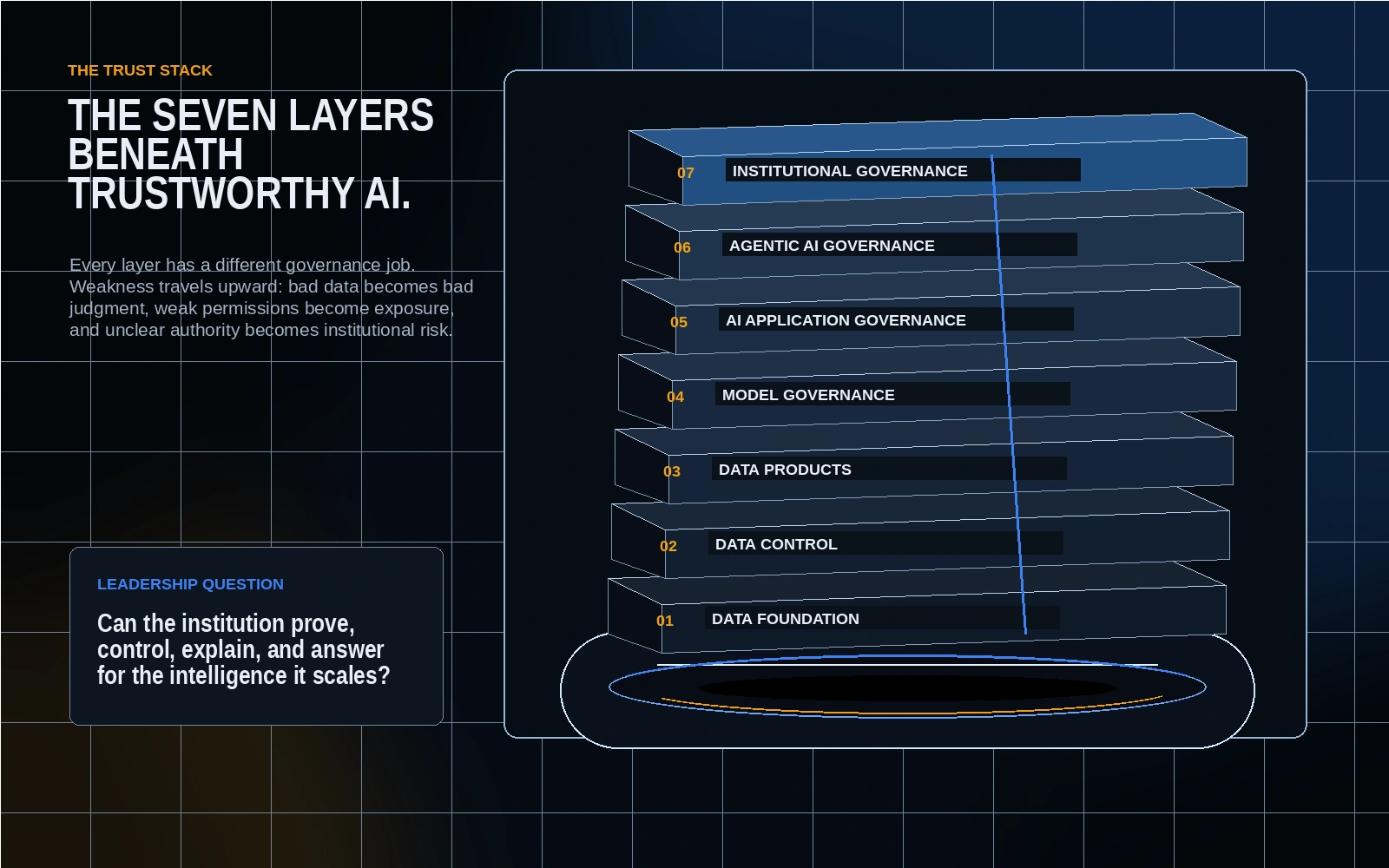
The Trust Stack is the book’s seven-layer method for governing the foundations beneath AI: data, controls, data products, models, applications, agents, and institutional accountability.
Prompts, policies, and model reviews matter, but they are not enough. AI depends on records, permissions, owners, applications, agents, controls, and institutional authority. If those layers are weak, the answer may look confident while the institution beneath it remains unable to prove, control, or answer for it.
Boardroom plate
Select a layer to see what it governs, how it fails, the leadership question it raises, and the tool the book introduces.
Weakness in one layer travels upward. Bad data becomes bad judgment. Weak permissions become exposure. Unclear ownership becomes disputed responsibility. Uncontrolled agents become institutional risk.
Ownership, definitions, lineage, quality, classification, retention, and authoritative sources.
Access, permissions, privacy, cybersecurity, logging, monitoring, retention, and escalation.
Reusable data assets with owners, metadata, quality rules, approved uses, and interfaces.
Model purpose, owner, risk tier, validation, testing, monitoring, drift review, and retirement.
Systems, copilots, RAG applications, workflow AI, assistants, and enterprise AI applications.
Agents that can see, say, change, trigger, remember, delegate, approve, or act.
Authority, funding, oversight, risk acceptance, accountability, audit, escalation, and board visibility.
Diagnostic visual
01
Critical data, AI systems, or decisions are used without accountable ownership.
02
Data is incomplete, inconsistent, stale, duplicated, or unsuitable for the decision.
03
AI sees, retrieves, combines, or exposes information beyond approved authority.
04
Responsibility is disputed after deployment because it was not assigned before use.
05
The organization cannot reconstruct the source, prompt, output, approval, decision, or action path.
06
Policies exist, but they do not constrain real operating behavior.
Part VI of the book turns the Trust Stack into the routines leaders need to govern: mission control, accountability, controls, and executive visibility.
01
Visibility, telemetry, incident intake, triage, containment, communication, evidence capture, recovery, and learning.
02
Named owners, decision rights, risk acceptance, escalation, pause authority, and answerability before deployment.
03
Reusable controls that make policy enforceable, measurable, evidenced, tested, and remediable.
04
A leadership view of systems, owners, risks, incidents, exceptions, remediation, assurance, and vendor exposure.